
Most Telegram resellers do not fail because they lack services. They fail because they pass Provider complexity directly to the customer. A buyer sees twenty versions of Telegram members, several view services with unclear differences, and boost packages described with internal labels that mean nothing outside the Provider dashboard.
A profitable reseller does the opposite. The Provider may supply the inventory, but the reseller decides how that inventory is tested, named, priced, explained, and supported. The public offer should be simpler than the backend, not a copy of it.
A Reseller Is Selling a Decision, Not a Service ID
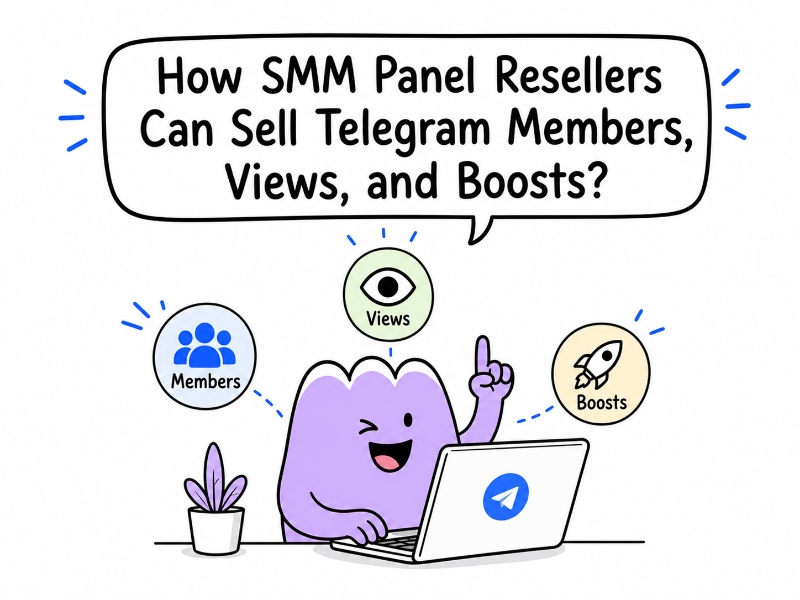
SMM panel resellers can sell Telegram members, views, and boosts by turning raw Provider services into clear offers built around customer outcomes. Members should address channel size and visible social proof, views should address post visibility, and boosts should be sold only for the specific boost-related result described by the service. Before publishing an offer, the reseller must test it, define its limits, write the correct link instructions, price for operational risk, and create a process for partial orders, drops, refills, and Provider changes.
A Provider service ID is an internal supply item. It is not a finished retail product. The Provider name may contain abbreviations, quality labels, estimated speeds, countries, refill periods, or account types that are useful to an operator but confusing to an ordinary Telegram channel owner.
The reseller’s first task is therefore translation. Not language translation, but commercial translation. What problem does the service solve? What must the customer submit? What result should they expect? What is outside the service scope?
Build the Catalog Around Buyer Situations
A weak catalog begins with the Provider list. A stronger catalog begins with the customer’s situation.
Someone launching a new channel may want the profile to look less empty. Someone promoting an important post may care about its visible reach. Another customer may already have a developed audience and need a specific boost service for a separate Telegram objective.
These customers should not be pushed through the same sales message. The reseller needs to identify the job each category performs.
Telegram members support the visible channel size
Members are usually purchased when the customer wants a stronger first impression, a larger visible audience, or a channel that does not appear newly created. The service should be described around that role.
Do not promise that a member order will produce readers, buyers, comments, clicks, or long-term community participation unless the service specifically provides and verifies those outcomes. A membership increase and audience engagement are different products.
Telegram views support the visible performance of a post
Views are attached to content rather than only to the channel profile. The customer may be promoting a pinned message, campaign announcement, product post, news item, or another post whose visible reach matters.
This makes views suitable for recurring orders, but it also creates more room for mistakes. The customer may submit a channel link instead of a post link, order for the wrong content type, or expect clicks and joins from a service that only promises views.
Telegram boosts require their own explanation
Boosts should not be placed under members or described as a stronger form of engagement. They serve a separate purpose and may depend on specific channel, account, duration, or Provider conditions.
The public description should state only what the current service can reliably support. When Telegram or the Provider changes a requirement, the reseller must update or pause the offer instead of continuing to sell an outdated description.
Customers who are unsure which signal they need may benefit from What Should You Buy First for Telegram Growth: Members, Views, or Reactions?. That decision should happen before the reseller tries to increase the basket size.
Reduce the Provider List Before Publishing It
A Provider may offer many versions of what appears to be the same service. Publishing all of them is rarely helpful. It creates choice without clarity and transfers the testing burden to the customer.
Before adding a Telegram service to the public catalog, the reseller should answer:
- What exact Telegram link or identifier does the service accept?
- Is it intended for channels, groups, posts, stories, or another format?
- What visible result does it provide?
- What does it not provide?
- How does delivery normally begin and progress?
- Is refill available, and under what conditions?
- What usually causes the order to become partial, canceled, or stuck?
- Can another active order interfere with it?
If two services produce nearly the same customer outcome, keep the one that is easier to explain and support unless the second option has a meaningful difference. That difference might be country targeting, account category, delivery method, capacity, or refill protection.
A smaller tested catalog can outperform a large unfiltered catalog. Customers make decisions faster, staff learn the services better, and order mistakes become easier to diagnose.
Write a Promise the Service Can Actually Keep
Every public service needs a narrow promise. The promise should describe the result the Provider can deliver, not every benefit the customer hopes to receive afterward.
For members, the promise may concern an increase in the visible member count, a particular account category, a target country, or defined refill coverage. For views, it may concern the number of views delivered to an eligible post. For boosts, it should reflect the specific boost-related outcome supported by the current service.
Avoid descriptions that combine unrelated claims:
- Guaranteed organic growth
- Guaranteed buyers or subscribers
- Guaranteed Telegram search ranking
- Permanent results with no conditions
- Real engagement from a service that only delivers a count
- Immediate completion when only the start time is fast
Those claims may increase initial conversions, but they also create Refund requests and support disputes because the customer judges the order against a promise the Provider never controlled.
The reseller is responsible for the public promise even when the Provider performs the delivery. “The Provider caused it” is not a useful answer to a customer who bought from your panel.
Test the Service as an Operator, Not as a Shopper
A test order should produce operational information. Seeing the quantity arrive is only one part of that test.
Record the submitted link, starting count, order time, Provider status changes, delivered quantity, completion status, and any later drop. Check whether the public description matched what actually happened.
Test one Provider service at a time on an appropriate channel or post. Overlapping orders make it difficult to identify which Provider delivered, dropped, refilled, or stalled.
For member services, evaluate the Provider claims, refill behavior, and retained quantity before increasing capacity. The guide on How to Check Telegram Member Quality Before Buying provides a useful quality-control framework that can also be applied by resellers.
Testing should continue after launch. Provider performance can change. A service that delivered consistently in previous orders may slow down, lose capacity, change its source, or begin returning more partial results.
Service approval is not permanent. Treat every public offer as an actively monitored product.
Price for the Full Cost of Selling the Order
Provider cost is only the first line in reseller pricing. A service that costs less at the source may become more expensive after support work, payment processing, refunds, currency movement, manual refill requests, partial-order adjustments, and Provider replacement.
The practical pricing question is not, “How much markup can I add?” It is, “What margin remains after an ordinary amount of service failure and customer support?”
Your selling price needs room for:
- The current Provider rate
- Payment gateway and transaction costs
- Refunds, credits, and partial completions
- Customer support time
- Testing and monitoring
- Price changes between Provider synchronization cycles
- A reserve for replacing unstable services
- Actual profit after those costs
A cheap service with frequent complaints may produce less profit than a more expensive service with stable delivery and clear conditions. The reseller should evaluate margin per completed and supported order, not only the difference between wholesale and retail prices.
Design the Order Handoff Before Automating It
Automation does not repair a confusing service. It only sends confusing orders faster.
Before connecting a Telegram service through an API, define the public name, accepted link format, quantity rules, customer-facing description, Provider mapping, status behavior, and failure response.
The customer should never need to know the Provider ID. Your system should map the public offer to the correct backend service and pass the required quantity and link in the expected format.
Build a response for every common status:
- Pending: Explain that the order has been accepted but delivery has not begun.
- Processing: Show that the Provider is delivering the order.
- Completed: Confirm the Provider marked the requested quantity as delivered.
- Partial: Credit or refund the undelivered portion according to your terms.
- Canceled: Return the appropriate balance and explain the likely link or service issue.
Technical implementation is covered more deeply in How to Connect a Telegram SMM Panel API to Your Website. The important business rule is to finalize the offer before automating the Provider connection.
Support Should Begin on the Service Page
Many support tickets are descriptions that arrived too late. The customer should have seen the relevant rule before submitting the order.
A useful Telegram service page should explain:
- The exact link format
- The accepted Telegram content type
- The expected start and delivery behavior
- Whether the result includes engagement or only a visible count
- Refill eligibility and duration where applicable
- Restrictions on overlapping orders
- What happens after a partial or canceled order
Keep these rules short enough to read but specific enough to prevent mistakes. Hiding essential conditions inside a long Terms page does not reduce support pressure if customers never see them during ordering.
The checkout or order form should reinforce the same instructions. For example, a post-view service should request a post URL and show an example of the accepted format. A member service should state whether a username, public channel link, or invitation link is required.
Know When to Pause a Telegram Service
Resellers often keep a weak service active because it still accepts orders. Acceptance is not the same as reliability.
Pause or replace a service when the public description no longer matches actual performance, partial orders become common, refill stops working, Provider support becomes unresponsive, or the link requirements change without notice.
Do not wait until complaints become unmanageable. A temporarily unavailable offer is easier to recover from than a catalog filled with services customers no longer trust.
The strongest Telegram reseller model is not the one with the most service IDs or the lowest visible prices. It is the one that consistently turns Provider inventory into offers customers can understand and the reseller can support.
Sell fewer promises, define them precisely, and monitor whether the Provider keeps them. That operating discipline is what turns Telegram members, views, and boosts from a raw catalog into a sustainable reseller business.